Hyperbaric medicine · Celje, Slovenia
Hyperbaric Oxygen Therapy (HBOT)
Hyperbaric oxygen therapy (HBOT) is a medical treatment in which you breathe 100% medical oxygen inside a pressurised chamber. Under pressure, far more oxygen dissolves in the blood plasma – enough to reach tissues with a poor blood supply.
At the OxySphere clinic in Celje, every course of treatment is medically supervised. It starts with an examination and follows a protocol tailored to your goal – whether that is treating a condition, recovering faster or staying well.
HBOT in three sentences
- 1You breathe pure medical oxygen in a chamber at raised pressure.
- 2Under pressure, oxygen dissolves directly into the blood plasma and reaches tissues that red blood cells struggle to supply.
- 3Researchers explain that alternating between high and normal oxygen levels over a course of sessions triggers tissue repair – including the growth of new blood vessels.
- 2.0–2.5 ATAtypical pressure
- 100%medical oxygen
- 90 minper session
How it works
What is hyperbaric oxygen therapy?
The patient breathes 100% oxygen in a special pressure chamber at increased pressure (usually between 2.0 and 2.5 ATA). This greatly increases the amount of oxygen dissolved in the blood and thus improves the oxygen supply to the tissues.
This speeds up wound healing and tissue regeneration, reduces inflammation and supports the treatment of many acute and chronic conditions.
- 1More oxygen in the blood
- 2Energy for cells
- 3Tissue regeneration
Note: HBOT supports medical treatment and does not replace consultation with or treatment by a doctor.

- 2.0–2.5 ATAusual therapeutic pressure
- up to 3.0 ATAmaximum pressure for which the chamber is certified
- 1.0 ATAatmospheric pressure at sea level
- 1More oxygen in the blood
- 2Energy for cells
- 3Tissue regeneration
100% medical oxygen90 minutesconstant supervision
Pressure in the chamber
Drag the pointer or the slider: compare the pressure with depth below sea level and with oxygen in the plasma.
Usual therapeutic pressure
Most sessions take place at 2.0–2.5 ATA. During the session you breathe 100% medical oxygen through a mask.
Comparable to the pressure at a depth of about 10–15 m below sea level.
At a depth of 10 m the pressure is about 2 ATA, and every further 10 m adds about 1 ATA. Source: NATO STO, Practical Application of Hyperbaric Oxygen Therapy (EN-HFM-245). Dissolved oxygen: estimate based on NATO STO EN-HFM-245-02 (Mutluoglu, Hyperbaric Oxygen Physiology) – arterial pO₂ with 100% oxygen 625 / 1356 / 1700 mmHg at 1.0 / 2.0 / 2.5 ATA, about 6.8 ml/dl at 3 ATA, solubility 0.003 ml/dl/mmHg; breathing air 0.32 ml/dl. Intermediate values are interpolated – an illustration, not a measurement.
-
1
More oxygen in the blood
– read the article in the knowledge base (in Slovenian, opens in a new tab)
Increased pressure allows up to 15 times more oxygen to dissolve in the blood plasma than with normal breathing.
-
2
Energy for cells
– read the article in the knowledge base (in Slovenian, opens in a new tab)
When cells receive more oxygen, their metabolism and ability to regenerate improve.
-
3
Tissue regeneration
– read the article in the knowledge base (in Slovenian, opens in a new tab)
It has been shown to speed up the closure of acute and chronic wounds, reduce swelling (oedema) and inhibit harmful inflammatory processes.
100% medical oxygen90 minutesconstant supervision
Why a course of sessions
The hyperoxic-hypoxic paradox: why rhythm matters
When oxygen levels fall quickly from very high back to normal after a session, cells read the change as a shortage of oxygen. According to researchers, this “false alarm” switches on repair and protective mechanisms – without exposing the body to any real oxygen deprivation.
During the session: hyperoxia
At raised pressure, the blood plasma and tissues carry far more oxygen than when you breathe normal air.
After the session: back to normal
Oxygen levels quickly return to normal. Cells respond to this drop much as they would to a lack of oxygen.
The repair signal
Researchers describe new blood vessel growth, an anti-inflammatory response and the release of stem cells – effects that build from one session to the next.
This is why a course of sessions at a sufficiently frequent rhythm matters. Short air breaks during a session reduce the overall oxygen load, and researchers believe they also amplify the fluctuation. Source: Hadanny & Efrati, The Hyperoxic-Hypoxic Paradox, Biomolecules, 2020.
Your journey
From first consultation to final session
Hyperbaric oxygen therapy is a medical treatment, so it always starts with an examination, follows an agreed plan and ends with a review of your progress. To see what a single session in the chamber is like, visit our hyperbaric chamber page.
- 1
Consultation and examination
Before your first session, a doctor examines you, reviews your medical records and assesses whether the therapy is suitable and safe for you.
- 2
Treatment plan
Based on your goal and your health, the doctor recommends the pressure, the number of sessions and how often to attend.
- 3
Your first session
You get to know the chamber and the team, and learn how to equalise the pressure in your ears. It is a multiplace chamber, so you are never on your own.
- 4
The course of sessions
Sessions follow the agreed schedule. If anything changes in how you feel, simply let the staff know.
- 5
Review
At the end of the course, the doctor reassesses your condition and decides with you whether to continue.
What the doctor checks
- ears and sinuses
- lungs, heart and blood pressure
- your current medication
- implants and previous surgery
What to bring to your first consultation
- medical reports and discharge letters related to your condition
- a list of your current medication
- details of any implants, e.g. a pacemaker
- the questions you would like to ask
Number and frequency
How many sessions do I need, and how often?
The body responds gradually. For recovery, sport and prevention, the first changes often appear sooner; in chronic and neurological conditions, they develop more slowly. Your doctor always recommends the number and frequency of sessions after the examination.
Recovery, prevention, sport
For regular recovery, after intense training and to maintain your results once an intensive protocol is complete. OxySphere Club membership is designed for this rhythm.
Health conditions
For more serious health problems, this is the minimum recommended frequency. A course runs over several weeks.
Recommended rhythm
Frequent enough to be effective, yet manageable for most treatment plans.
More complex conditions
For more complex conditions – in line with most clinical studies, where sessions were given five times a week.
Example: how long a course of 40 sessions takes
- 1
12 sessions
Injury healing
In severe crush injuries of the limbs, complete healing was achieved in 17 of 18 patients, compared with 10 of 18 after placebo treatment.
Bouachour et al., 1996 - 2
20 sessions
The biological foundations
After a course of 20 sessions, the number of bone marrow stem cells in the blood – cells involved in tissue repair – rose roughly eightfold.
Thom et al., 2006 - 3
40 sessions
Recovery and performance
Patients six months to three years after a stroke showed better movement and greater independence. In experienced middle-aged athletes, maximal oxygen uptake increased.
Efrati et al., 2013; Hadanny et al., 2022 - 4
60 sessions
The longest arc
In healthy adults aged 64 and over, telomeres in some blood cells lengthened by more than 20%, and the proportion of senescent cells fell by more than a third.
Hachmo et al., 2020
Realistic expectations: everyone responds differently, and study results describe groups of patients. That is why the doctor proposes a course that matches your goal, and adjusts it at the review if needed.
Further reading
Learn more about how it works
Articles by the OxySphere Medical editorial team that explain, in plain language, what happens in the body during treatment. The articles are currently available in Slovenian.
- When the bone marrow sends help: oxygen and stem cellsSL 18 min read
- How hyperbaric oxygen therapy worksSL 22 min read
- Oxygen chambers: what sets medical therapy apart from wellnessSL 18 min read
- Does hyperbaric oxygen therapy promote cancer? What the research showsSL 14 min read
- The immune system and hyperbaric oxygen therapy: what the research showsSL 13 min read
- Nerve regeneration: dormant neurons can reawaken years after an injurySL 11 min read
- White blood cells and oxygen: HBOT for stubborn infectionsSL 11 min read
- Neovascularisation: new blood vessels can grow where old ones have failedSL 11 min read
- Tissue perfusion: oxygen can reach cells that blood cannotSL 12 min read
To see which conditions the therapy is officially recognised for, and where research is ongoing, visit Indications.
Frequently asked questions
Before you decide
Can’t find an answer? Give us a call.
+386 70 80 81 00Therapy
Is it cramped in the chamber? What if I am claustrophobic?
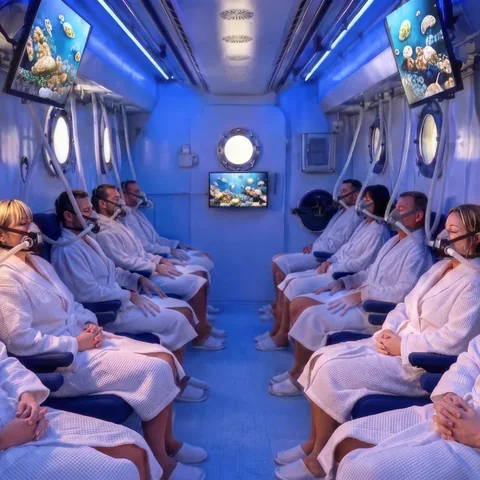
The BAROKS chamber is the largest multiplace medical hyperbaric chamber in Slovenia, with 11 seats. The interior is air-conditioned, lit with ambient LED lighting and equipped with four TV screens. It is designed for comfort and space, and its rectangular shape further reduces any feeling of confinement.
You are not alone during the session – our staff are with you in the chamber, and the session is also monitored by cameras.
If you are worried about feeling confined, mention it at the consultation or assessment. In cases of severe claustrophobia, the doctor decides whether the therapy is suitable.
How many sessions do I need?
The number of sessions is determined by the doctor at the initial assessment – based on your health, your goals and how you respond to the therapy.
The effects of hyperbaric oxygen build up gradually. Better oxygen supply to the tissues begins during the session itself, while processes such as the formation of new small blood vessels develop over several weeks and require a series of consecutive sessions.
As a guide: the studies we summarise in our knowledge base used protocols of roughly 20 to 60 sessions – for example 40 sessions in a study on athletes and 60 sessions (five per week) in a study on brain ageing; late effects of radiotherapy often require 30–60 sessions. Patients who have shared their experience with us mostly completed between 10 and 30 sessions.
Example protocol: a study on healthy brain ageing (in Slovenian)(opens in a new tab)
Safety and preparation
Why is a medical assessment needed before the first session?
Hyperbaric oxygen therapy is a medical procedure, so nobody enters the chamber without a prior medical assessment. The doctor reviews your health and medications, discusses your goals, rules out any contraindications and sets the protocol – the number of sessions and the pressure. Before the assessment you fill in a health questionnaire.
HBOT is not possible, for example, with an untreated pneumothorax, an acute upper respiratory infection, severe middle-ear disease or treatment with certain chemotherapy drugs. In cases of epilepsy, severe claustrophobia, serious cardiovascular disease, pregnancy, poorly controlled diabetes or after recent surgery, the doctor decides whether it is suitable.
The assessment is included in the price of every package.
Is hyperbaric oxygen therapy safe?
Sessions take place in a clinic licensed by the Slovenian Ministry of Health, in a medically certified BAROKS chamber, under the supervision of a doctor and trained healthcare staff. Before the first session the doctor rules out contraindications, and during the session staff monitor your well-being, the pressure and the oxygen concentration.
In properly selected patients, side effects are mostly mild. The most common is ear pressure or mild ear barotrauma. Serious complications are very rare.
Source: Turning back the biological clock (knowledge base, in Slovenian)(opens in a new tab)
Packages and payment
Is the cost covered by health insurance?
Treatment at our clinic is self-funded and charged according to our published prices. You don’t need a referral – just call us or send an enquiry.
With a package, the price per session drops to as little as €60, and customers in Slovenia can also pay the total in instalments.
Can I pay in instalments?
Yes – customers in Slovenia can pay for session packages in instalments through Leanpay, with no down payment.
- Let us know at the clinic that you’d like to pay with Leanpay.
- You receive a secure link by SMS to enter your details.
- You get a decision within moments and can start your sessions straight away.
You can check your limit free of charge before your visit.
Terms and procedure: Instalment payments with Leanpay (in Slovenian)(opens in a new tab)

Free consultation
Is hyperbaric therapy right for you?
Find out for free – no obligation.
From faster recovery after illness and injury to longevity and elite sports recovery – tell us about your current health challenges or goals. Our expert team at OxySphere Medical will review your case and give you an evidence-based opinion on whether the therapy could help you recover faster and feel better.
- We review your caseYour question is reviewed by our expert team.
- We reply by emailAs soon as possible, depending on current demand. If needed, we will also call you.
- If you wish, we book your medical assessmentA doctor makes the final decision after the assessment.
- Licensed by the Slovenian Ministry of Health
- 4.9 on Google · 23 reviews
Note: the free consultation takes place remotely and is for information only. Whether the therapy is suitable for you is decided by a doctor at the mandatory medical assessment.
Your data is safe and strictly protected. The consultation is free and does not commit you to a purchase.
Thank you for getting in touch!
We have received your enquiry. We will reply by email as soon as possible, depending on current demand. If needed, we will also give you a call.

Visit us in Celje
- Opekarniška cesta 1, 3000 Celje, Slovenia
- +386 70 80 81 00
- info@oxysphere.si
- Reception Mon–Thu 8:00–19:00, Fri 8:00–15:00. Therapy sessions (at scheduled times) and medical consultations by prior appointment only.
- Free parking
- Wheelchair access
- Public transport nearby
Directions, parking and access
Directions(opens in a new tab)